
Scalp products market a long list of ingredients — biotin, argan oil, peppermint, caffeine, peptides — with varying degrees of clinical evidence behind them. Some have strong, replicated study data. Some have preliminary evidence from small studies. Some have no meaningful evidence at all beyond marketing claims. This is an honest accounting of where the evidence stands on the most commonly marketed scalp ingredients.
This article is informational and does not constitute medical advice. For scalp conditions — seborrheic dermatitis, psoriasis, alopecia areata — consult a board-certified dermatologist for diagnosis and treatment recommendations.
Strong clinical evidence
Ketoconazole (antifungal). The most evidence-backed ingredient for seborrheic dermatitis and dandruff. Multiple RCTs demonstrate efficacy in reducing Malassezia-driven flaking and inflammation. Available OTC at 1% (Nizoral AD) and by prescription at 2%. Evidence quality: high.
Selenium sulfide. The active ingredient in Selsun Blue. Reduces Malassezia growth by mechanisms distinct from ketoconazole, and has decades of clinical use supporting its efficacy in dandruff and seborrheic dermatitis. Evidence quality: high.
Zinc pyrithione (ZPT). The active ingredient in Head & Shoulders. Well-studied antifungal and antibacterial that reduces Malassezia. Effective for maintenance of mild dandruff. Evidence quality: high.
Salicylic acid. Keratolytic — breaks down the bonds between skin cells to accelerate shedding of scale buildup. Effective for scalp psoriasis scale and seborrheic dermatitis flaking. The AAD includes it in psoriasis treatment guidelines. Evidence quality: high for scale reduction; moderate for anti-inflammatory effects.
Minoxidil. The only FDA-approved topical ingredient for androgenetic alopecia (pattern hair loss). Works by extending the anagen (growth) phase of the hair cycle and increasing follicle size. Available OTC at 2% (women) and 5% (men and women). Evidence quality: high for its specific indication.
Moderate evidence
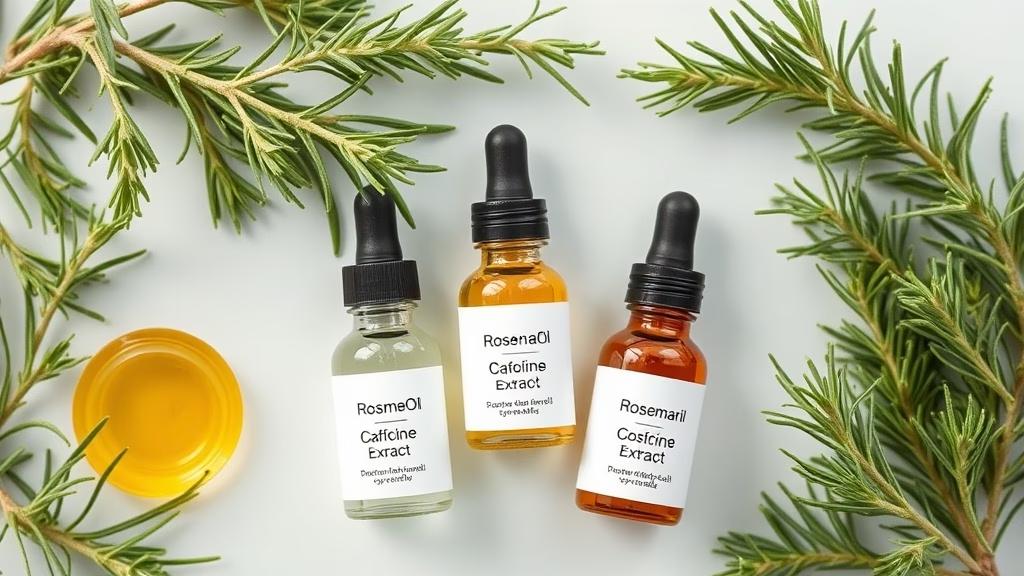
Caffeine (topical). Several studies suggest topical caffeine may counteract the DHT-driven miniaturization of hair follicles in androgenetic alopecia. A 2014 study in the International Journal of Dermatology found caffeine-containing shampoo produced hair growth comparable to minoxidil in one endpoint. Evidence is preliminary and limited by study quality. Evidence quality: moderate.
Rosemary oil. A 2015 study in Skinmed found rosemary oil performed comparably to minoxidil 2% in reducing hair loss over six months with fewer side effects (primarily scalp tingling with minoxidil). Evidence quality: low-moderate — replication in larger studies is lacking.
Weak or no clinical evidence
Biotin (topical). Oral biotin deficiency causes hair loss, but most people are not biotin-deficient, and there is no reliable evidence that topical biotin improves scalp health or hair growth in non-deficient individuals. Evidence quality: insufficient.
Argan oil, castor oil. Conditioning agents that may improve hair shaft appearance but have no meaningful clinical evidence for scalp health, follicle function, or hair growth. Evidence quality: insufficient for scalp health claims.
Peppermint oil. One small study showed scalp vasodilation. No clinical significance has been established. Evidence quality: insufficient.
See our scalp treatment reviews for products evaluated on these criteria, or our scalp serum guide for more on ingredients marketed for hair growth.